On March 24, 2026, day 25 of the war that began with Operation Epic Fury, the gap between American narrative and battlefield reality reached a breaking point. From the White House Oval Office, President Donald Trump declared the war won, claimed negotiations with Iran are underway “right now,” and said Tehran has offered the United States “a very significant prize” linked to reopening the Strait of Hormuz. In those same hours, Iranian ballistic missiles struck a residential building in Tel Aviv, Saudi Arabia shot down 19 drones over its Eastern Province, Kuwait suffered partial blackouts from air defense debris, and sirens wailed in Bahrain. The Strait of Hormuz remains blocked. The 82nd Airborne Division is departing for the Middle East. Iranian deaths exceed 3,200 according to NGOs, including over 200 children.


This is not a chronicle of approaching peace. It is the anatomy of a method.
From “We’ll Obliterate the Plants” to “Productive Conversations”: 24 Hours of Reversals
The sequence of events is key to understanding what is happening. On Saturday, March 22, Trump issued a public ultimatum: if Iran did not reopen the Strait of Hormuz by Monday evening, the United States would strike Iranian power plants until “obliterating them.” Iran responded with escalation: attacks on Israel and Gulf states allied with the US, and threats to mine the entire Persian Gulf and strike regional energy infrastructure.
Monday morning, without warning, Trump reversed course. In an all-caps post on Truth Social, he announced “good and productive conversations” with Tehran and postponed the ultimatum by five days. Markets reacted immediately: Asian stocks rose, oil prices fell. The Financial Times reported that half-billion-dollar bets on the oil market were placed fifteen minutes before Trump’s post—a detail regulators cannot ignore.
Tuesday, in the Oval Office, Trump completed the narrative arc by declaring victory: “We won this war. This war has been won,” he told reporters. He claimed Iran offered a “very significant prize” without specifying its nature, described the situation as “regime change” because “the leaders are all very different from the ones we started with,” and indicated that Vice President JD Vance, Secretary of State Marco Rubio, envoy Steve Witkoff, and son-in-law Jared Kushner are leading negotiations.
“We Negotiate with Bombs”: The Hegseth Doctrine
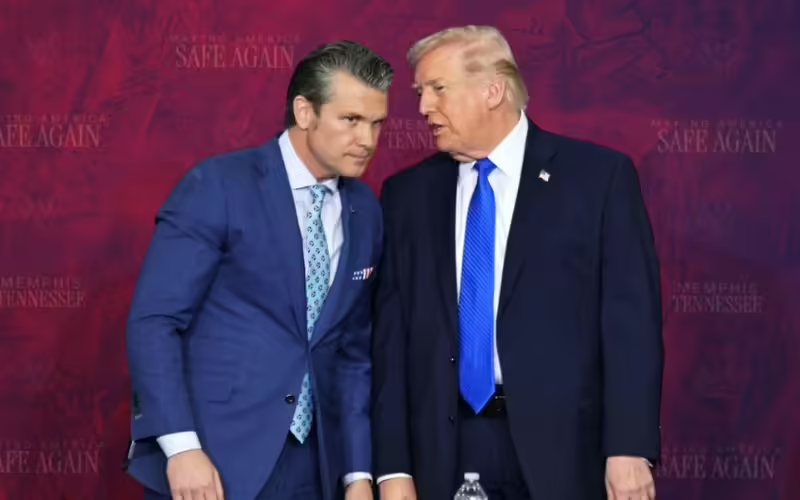
The day’s most revealing moment came not from the president but from his Defense Secretary. Speaking alongside Trump in the Oval Office, Pete Hegseth declared the Pentagon considers itself integral to the negotiation: “The air campaign we conducted, that Israel conducted alongside us, has been a textbook campaign. And it’s because we have a president who, when he sends his fighters to fight, unties their hands to go destroy the enemy as ferociously as possible from the first moment. And that’s why we consider ourselves part of this negotiation. We negotiate with bombs. You have a choice, as we fly over Tehran, about your future.”
Trump himself added a detail that in any other context would be a diplomatic scandal: he said Hegseth and Joint Chiefs Chairman General Dan Caine were “the only two people rather disappointed” by the prospect of negotiation because “they weren’t interested in a deal, they were interested in just winning.” The president described this as “a good attitude.”
Hegseth’s statement is not rhetorical excess. It is the public formalization of a method: American diplomacy in the Iranian conflict is not separate from military action—it is its narrative consequence. You bomb, then declare victory, then offer peace as the victor’s concession. The fact that the American Defense Secretary explicitly says “we negotiate with bombs” on camera, in an office where those who signed the Camp David Accords once sat, is a fact that must be registered in its enormity.
Tehran Denies, but Messages Flow: Pakistan’s Role
On the Iranian side, the public position is total denial. Foreign Ministry spokesperson Esmail Baghaei declared there is “no dialogue” with Washington. Parliament Speaker Mohammad Bagher Ghalibaf called negotiation reports “fake news.” The Revolutionary Guards called Trump “a lying American president” whose “contradictory behavior will not distract us from the battlefield.” The supreme command spokesman declared armed forces will fight “until complete victory.”
But beneath public rhetoric, channels are functioning. A senior Iranian Foreign Ministry official told CBS News that Tehran has “received points from the United States through mediators” and is “examining them.” NPR confirmed indirect channels exist: Pakistan, Egypt, and Turkey are transmitting messages between parties. Iranian Foreign Minister Abbas Araghchi spoke during the week with counterparts from several countries.
Pakistan has emerged as the primary mediator. Prime Minister Shehbaz Sharif publicly declared Islamabad “is ready and honored to host talks” between the US and Iran. Trump reshared the post without comment on Truth Social. An Israeli official confirmed to NPR that preparations are underway for a meeting in Pakistan by week’s end. According to Axios, the US and mediators believe a high-level meeting is possible on March 26 if Iran agrees. But three Pakistani officials told PBS that “quiet diplomacy” became more complicated after news leaked.
Pakistan is a logical but delicate choice: the only Muslim nuclear state, it maintains relations with Washington, Tehran, and Gulf monarchies. But it has also just signed a defense agreement with Saudi Arabia committing both countries to treat aggression against one as a threat to both—a constraint that, in a war context against Iran, complicates presumed neutrality.
Zolghadr: The Revolutionary Guards Hawk Replacing Pragmatist Larijani
While Trump declares “regime change” has occurred in Iran, reality points in the opposite direction. Iran has appointed Mohammad Bagher Zolghadr as new secretary of the Supreme National Security Council, replacing Ali Larijani, killed in an Israeli raid last week.
Zolghadr is no pragmatist. He is a former Revolutionary Guards brigadier general who served in the Iran-Iraq War, led the Pasdaran (Revolutionary Guards) joint staff for eight years, served as deputy commander for another eight, and was deputy interior minister for security under Ahmadinejad—a post then interpreted as strengthening Pasdaran military influence in civilian politics. Analyst Vali Nasr commented that the appointment “confirms that all Israel’s decapitation achieved was transferring power in Tehran to the most intransigent part of the Pasdaran.” Ghalibaf, the parliament speaker Washington seems to consider a possible interlocutor, “may be the appealing ticket for the White House, but Zolghadr is the reality on the ground.”
The appointment came with approval from new Supreme Leader Mojtaba Khamenei—who has not appeared publicly since succeeding his father, assassinated in early March. The signal is unambiguous: the regime is not opening up but closing around its hardest core.
Strait Remains Closed, IEA Warns: Worse Than the Seventies
While diplomacy produces statements and counter-statements, the war’s material reality is measured in the Strait of Hormuz. The IRGC (Islamic Revolutionary Guard Corps) confirmed Tuesday it repelled a container ship flying the St. Kitts and Nevis flag transiting from the Strait for being “without transit authorization.” The Strait remains de facto under Iranian control. US intelligence has identified at least a dozen Iranian submarine mines (Maham 3 and Maham 7 models) in the passage. At least 16 merchant vessels have been attacked since the war began.
Fatih Birol, director of the International Energy Agency, declared Monday the situation is “very serious” and the current energy crisis is “worse than the two oil crises of the seventies and the consequences of the Ukraine war combined.” The Eurozone is registering early stagflation data: production costs rising, output stagnating, consumer confidence at its lowest since October 2023.
War as Narrative: Declaring Victory to Make It True
Former Deputy Secretary of State Wendy Sherman offered the day’s most lucid reading in a WBUR interview: “I wish I could be more optimistic that this is the moment to end the war through negotiation. Our superb military apparatus has degraded Iran’s missile and nuclear program, but it has not achieved what President Trump hopes. And it certainly hasn’t reopened the Strait of Hormuz, which is vital to the world economy.” Sherman recalled that Iran has already negotiated twice with the United States—in June and October 2025—and both times talks were followed by military aggression. “They are very wary of negotiating with the United States.”
The Trump method is narrative before diplomatic. You declare victory to create the domestic political conditions that make it sustainable. You announce negotiations to lower oil prices and calm markets. You praise your generals for their reluctance toward peace as a demonstration of strength. You bomb and simultaneously extend a hand, forcing the adversary to choose between two equally unfavorable options: accept conditions dictated under bombardment or refuse and face escalation.
But the method has a structural limit: it only works if the adversary collaborates with the narrative. Iran is not doing so. It denies talks, appoints hawks, continues striking, controls Hormuz. And every day that passes without the Strait reopening, the war’s economic cost falls not on Iran but on Europe and Asia—the economies that depend on energy transit that Iran has the power to block.
Sources
NPR – Trump declares victory and claims Iran offers a ‘prize’ in talks Iran has denied having (24 marzo 2026)
CNN – Live updates: Iranian source says US initiated ‘outreach’ to end war (24 marzo 2026)
CBS News – Live Updates: Iran war rages with Pentagon expected to send troops (24 marzo 2026)
NBC News – Trump postpones attacks on Iran power plants, citing ‘productive’ talks (24 marzo 2026)
Washington Post – Trump declares Iran war ‘won’ as Tehran denies claims (24 marzo 2026)
Al Jazeera – Iran names Zolghadr as successor to security chief killed in US-Israeli attack (24 marzo 2026)
Al Jazeera – Trump postpones military strikes on Iranian power plants for five days (23 marzo 2026)
Euronews – Iran fires new wave of missiles after denying Trump talks (24 marzo 2026)
Newsweek – Iran war live updates: US, Iran could hold high-level talks this week (24 marzo 2026)
PBS – Strikes hit Iran while Tehran targets Israel and Gulf states amid mixed signals (24 marzo 2026)
WBUR – Why a former top diplomat says the Iran war isn’t likely to end anytime soon (24 marzo 2026)
Fox News – Pakistan struggles to stay neutral as the Iran war intensifies (23 marzo 2026)
The Week – Who is Mohammad Bagher Zolghadr? (24 marzo 2026)


