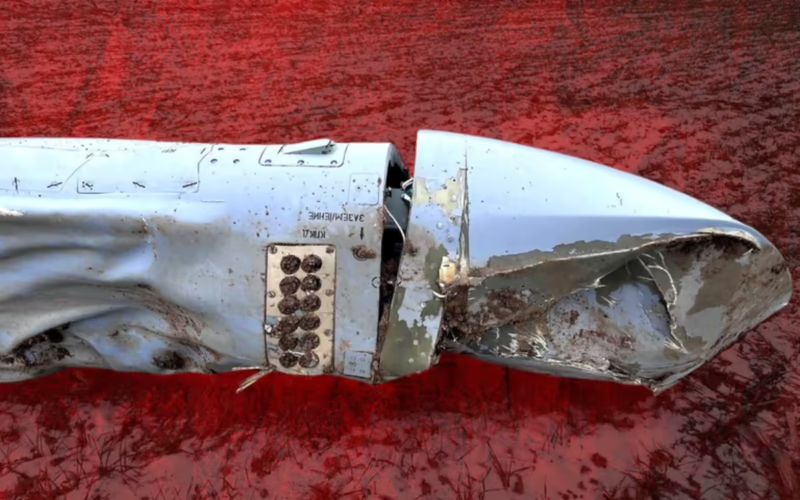
Overnight from Thursday, November 19, into Friday, November 20, three Russian objects crossed into Polish airspace during one of Moscow’s heaviest barrages on Ukraine. A Kh-101 cruise missile came down in a field at Nowy Lipowiec, about 60 kilometers from the Ukrainian border and a few hundred meters from people’s homes. A second object, most likely another missile, crashed at Rudnik nad Sanem; the third, almost certainly a jet-powered drone, at Mołodycz. All three sites are in southeastern Poland. Nobody was hurt and no critical infrastructure was hit.


“There has been a violation of Polish airspace and an incursion by objects from the Russian Federation,” Defense Minister Władysław Kosiniak-Kamysz told reporters. Interior Minister Marcin Kierwiński said investigators are working all three sites.
A long night over southeastern Poland
The first alert went off at 1:40 a.m. Pairs of Polish F-16s and Swedish Gripens flew all night, Patriot batteries were switched on near Rzeszów-Jasionka airport and Świdnik, and by morning two NATO AWACS radar planes were circling over the country. In Rzeszów, Poland’s air navigation agency halted flights for military operations and air traffic controllers were evacuated. At 6:50 a.m. residents of the Lublin and Subcarpathian regions got air-raid warnings on their phones.
Warsaw calls it a deliberate provocation
Prime Minister Donald Tusk had no doubt where the objects came from. “It seems we are dealing with an intentional provocation,” he said, calling it “another instalment in the Russian escalation.” And he turned it into a political demand: Poland, he said, “must participate in decisions and discussions regarding the future of Ukraine” and Europe’s security.
That’s a shift. When another Kh-101 blew up in eastern Poland at the end of July, Tusk said there was no reason to think Poland had been the target. This time Warsaw is talking intent, and its main piece of evidence is the calendar.
From November 9 to 22, not far from the crash sites, Nowa Dęba is hosting Koalicja 2026, the first military exercise of the Coalition of the Willing: some 2,800 troops from eleven countries, led by France and Britain, in the first field test of the force Kiev’s backers want to send into Ukraine. On Friday the defense ministers of France, Britain and the Baltic states were there, along with eight chiefs of staff. Kosiniak-Kamysz said it was “hard to regard it as a coincidence” that the time and place of the violation lined up with the drills. The exercise went ahead as planned.
NATO: solidarity, AWACS and Rutte in Warsaw
NATO Secretary General Mark Rutte spoke with Tusk about the “grave violations of Polish airspace,” noted that allied jets had scrambled and said the alliance stands with Poland. He’s due in Warsaw on Saturday. Kosiniak-Kamysz plans to ask him for more troops and kit for Eastern Sentry, the eastern-flank air defense mission launched in September 2025, and above all for more AWACS. Nobody is talking about Article 4, the emergency allied consultation Warsaw triggered in September 2025 after some twenty Russian drones crossed the border. Not yet, anyway.
The view from Moscow
Russia’s embassy in Warsaw didn’t answer Reuters’ questions. But the Russian backdrop is on the record. On Thursday in Shenzhen, Vladimir Putin promised that Russia’s response to the strikes on the Crimean Bridge would be “much more painful.” Overnight, missiles hit three bridges over the Dnieper in Kiev; the Russian Defense Ministry says it struck road and rail bridges used to move weapons to the front. Ukraine’s air force counted 84 cruise missiles and 404 drones, plus ballistic missiles; Zelensky put the death toll at eight.
Moscow has also been clear about the Coalition of the Willing. Back in July, Foreign Ministry spokeswoman Maria Zakharova warned that any troops from its member states deployed in Ukraine would be “legitimate military targets” for Russia and would amount to foreign intervention.
The people on the border pay the bill
Whether this was deliberate is Warsaw’s claim, and the investigation will show how much proof there is beyond timing. What’s beyond dispute is this: while leaders talk peace in Shenzhen and Berlin, southeastern Poland is rehearsing troop deployments to Ukraine and catching missiles aimed at Kiev. The deeper Europe wades into this war, the more the war spills into its farm fields. Another AWACS won’t keep the families of Nowy Lipowiec safe. A seat at the peace table, with Europe speaking for itself, might.
Sources
- HuffPost (Reuters) — Poland condemns Russian ‘provocation’ after three airspace violations (November 20, 2026)
- Notes from Poland — Two Russian missiles and a drone hit Poland, says defence minister (November 20, 2026)
- Ukrainska Pravda — Two Russian missiles and jet drone violate Polish airspace (November 20, 2026)
- International Business Times — Russian missiles and drone land in Poland during attack on Ukraine (November 20, 2026)
- Kyiv Independent — Russian missiles and drone fall on Poland during attack on Ukraine (November 20, 2026)
- Al Jazeera — Russia unleashes retaliatory barrage on Kyiv bridges (November 20, 2026)
- Interfax — Putin’s remarks in Shenzhen (November 19, 2026)
- Ukrainska Pravda — First Coalition of the Willing military exercises kick off in Poland (November 9, 2026)
- NATO — NATO launches Eastern Sentry (September 12, 2025)
- TASS — Zakharova on Coalition of the Willing troops in Ukraine (July 15, 2026)
- Al Jazeera — NATO jets scramble as Russian missile detonates in Poland (July 30, 2026)