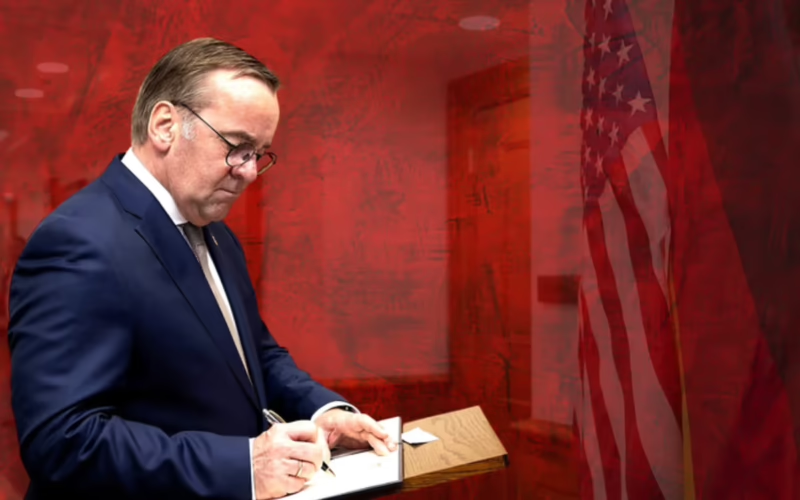
Boris Pistorius has walked back the word. Not the position. Germany’s defense minister says he’s sorry for calling Elbridge Colby’s take on Ukraine’s deep strikes into Russia “quite a stupid thing.” Colby is the Pentagon’s under secretary for policy, the man who writes Washington’s defense strategy. Pistorius told Politico on Friday, November 20, that he phoned Colby on Wednesday, apologized for his choice of words, and made clear the two still don’t see eye to eye. Reuters picked up the interview.


What Pistorius actually said
“In hindsight, I actually think the choice of words was inappropriate,” Pistorius said. “I didn’t really think it was appropriate even shortly after.” And: “I shouldn’t have done that.” He chalked it up to a clumsy phrase from a non-native English speaker at a press conference. On the call: “I apologised for my choice of words, but I also made it clear” that the two have “different views on the matter,” adding that Colby “sees it the same way.” Neither the Pentagon nor Colby had any comment.
So Berlin is fixing its tone with Washington, not its policy. For Chancellor Friedrich Merz’s government, Ukraine hitting targets deep inside Russia is still the right call.
Tuesday in Brussels: “spectacle” vs. “stupid”
The blowup came on Tuesday, November 17, at the Ukraine Defense Contact Group meeting at NATO headquarters in Brussels, the so-called Ramstein format. Colby didn’t sugarcoat it. “While the public conversation focuses on the spectacle of deep strikes designed to inflict pain on the Russian population,” he said, Washington’s assessment is that “such strikes have not been effective in driving an end to the war, nor do they contribute to blunting Russia’s advances on the front line.” He singled out hits on Wildberries, Russia’s online retail giant, and said strikes on civilian infrastructure have probably “hardened the Russian public’s resolve and the Kremlin’s own willingness to escalate.”
He wasn’t telling Kiev to stand down. “This is not to say that Ukraine should be forced to fight with its hands tied behind its back,” Colby said. The US wants to focus support on the front lines and “associated midrange strikes,” where Ukraine’s army is “very effective.”
Pistorius fired back that criticizing strikes in Russia “to destroy strategic military and military-used targets” was “quite a stupid thing,” and said everyone should be talking instead about “the terroristic strikes every night and every day” on Ukraine’s energy, water and heating. Britain’s Wes Streeting backed him: “It’s not for us to tell Ukraine how to fight their war,” he said, arguing the strikes have “helped to degrade Putin’s war machine, buying time and saving lives.” Ukraine’s defense minister, Yevhenii Khmara, went further: “For every strike they launch against our territory, we will respond twice or three times as forcefully,” he said, promising more long-range firepower next year. According to The Telegraph, Colby left before Khmara’s classified briefing.
Wildberries: a warehouse, not a front line
Colby’s example wasn’t random. On July 18, Ukrainian drones slammed into two big Wildberries logistics hubs, in Kotovsk and Elektrostal, killing eight workers. Kiev says the company handles military supplies; the Kremlin denies it. On July 21, Kremlin spokesman Dmitry Peskov called the situation “difficult,” pointing to losses for the company and for small and mid-sized businesses. More than a million sellers trade on the platform. Blowing up a parcel depot doesn’t move the front line an inch. It hits the people who work there and the people who sell through it. That’s where Washington and Berlin part ways.
Who calls the shots, who picks up the tab
Colby’s assessment is the Pentagon’s. Europe brushes it off and keeps paying: in Brussels, Germany put $300 million into a Patriot missile package coordinated with Norway. America builds the weapons, European taxpayers foot the bill, and the strategy gets argued somewhere else.
Berlin is doubling down while its voters drift away. In a YouGov poll taken November 13-16, the AfD, which opposes sending more weapons to Kiev, sits at 29 percent, ten points ahead of Merz’s CDU-CSU at 19. Back in March they were tied at 26.
The apology closes a diplomatic spat, not the rift. The Pentagon measures this war by results at the front. Berlin keeps measuring it by loyalty to Kiev’s cause. Caught in between are European taxpayers and the peoples on both sides of the border who actually live through the war. A Europe that wanted a real say would start by asking who benefits from a strike that brings peace no closer.
Sources
- Business Recorder (Reuters) — German minister sorry for calling Pentagon official’s view ‘stupid’ (November 20, 2026)
- ThePrint (Reuters) — German minister sorry for calling Pentagon official’s view ‘stupid’ (November 20, 2026)
- Kyiv Independent — Germany, UK push back after US criticizes Ukraine’s deep strikes into Russia (November 18, 2026)
- Arab News (AP) — US tells Ukraine’s backers deep strikes don’t work (November 17, 2026)
- Stars and Stripes — Colby, NATO allies split over Ukraine’s deep strikes (November 18, 2026)
- Reuters via Internazionale — Kremlin says Wildberries suffered losses in warehouse attacks (July 21, 2026)
- dawum.de — YouGov Bundestag poll, November 13-16, 2026