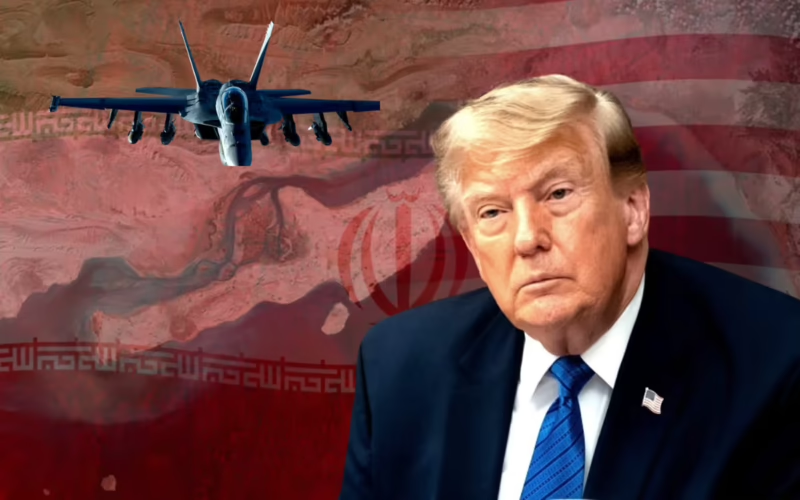
The US hit back on Tuesday, and this time it didn’t stay quiet about it. On November 17, American fighter jets dropped precision munitions on a Revolutionary Guards missile launch site on Qeshm Island, Iran’s big island in the Strait of Hormuz. The strike came hours after Iran’s third drone attack in five days on US military targets in Bahrain. There was no Pentagon statement: a US military official confirmed the hit on condition of anonymity to the Associated Press, Reuters, ABC and Air & Space Forces Magazine.


The war that kicked off on February 28, and was supposed to be over in a matter of weeks, is now in its eighth month. The roughly two-month lull in the fighting is over.
The Qeshm strike, billed as self-defense
Washington calls it self-defense. “The strike was in response to IRGC aggression targeting U.S. personnel and assets,” the official told Air & Space Forces Magazine. No damage assessment has been released.
Qeshm is a familiar target by now. According to the AP, the US has been periodically carrying out what look like limited strikes on the island and other Iranian targets throughout November, mostly unannounced. Air & Space Forces Magazine dates the run of quiet strikes back to early September.
On the Iranian side, Ahmad Nafisi, deputy governor of Hormozgan province, told the state news agency IRNA that the strike caused no damage to residential, commercial or infrastructure areas and that the situation on the island was under control.
Three hits on Bahrain in five days
Tuesday morning the Guards sent drones at the US radar at Isa Air Base in Bahrain, the small Gulf kingdom that hosts the US Navy’s Fifth Fleet. On Friday, November 13, they had gone after an early-warning radar; on Sunday, November 15, a radar system at an American helicopter base. Tehran claimed a hit. US Central Command said the drones were “intercepted without any damage to U.S. equipment or injury to American personnel,” and Bahrain’s military said they were “intercepted and destroyed.”
The Guards say they’re answering US strikes on Iranian communications towers and the drones Washington keeps flying over their territory. “Continued aggression against the country’s airspace, as well as the use of regional military bases and facilities for hostile acts against Iran, will not go unanswered,” the IRGC said in a statement.
Guards spokesman Hossein Mohebbi charged Bahrain with three mistakes: “cooperating in the invasion of the Islamic Republic of Iran,” “remaining within the US security bubble” and “encroaching on the sanctity of Shiite religious authority.” That last one points to a ruling handed down days earlier, when a Bahraini court sentenced 64 people, most of them Shiite clerics, to terms of up to life in prison for colluding with Iran. Tehran’s foreign ministry called the charges baseless.
Egypt, Qatar, Saudi Arabia and the UAE all condemned the attack as a violation of Bahrain’s sovereignty.
Tankers on fire, claims nobody can check
The tit-for-tat comes wrapped in claims nobody has been able to confirm. The Guards say they shot down a US MQ-1 drone; the Guards and Iran’s navy say an LNG carrier and two oil tankers caught fire in the strait. Reuters said it couldn’t verify either. What’s not in doubt is that attacks on tankers have picked up this month: the UK Maritime Trade Operations center says crew members are missing from a tanker hit north of Khasab, in Oman.
Oil barely flinched. Brent crude was up 0.4% at $92.76 a barrel on Tuesday, well off April’s wartime peak of $126.41. What’s keeping a lid on prices is the convoy system: tankers moving through the strait under US military escort have brought Gulf shipments back to roughly prewar levels, while the US naval blockade, in place for months, chokes off Iran’s crude exports.
No war, no peace, three carriers
Trump says new strikes are “highly unlikely.” He has also sent a third aircraft carrier and thousands more troops to the Middle East, and told Vice President JD Vance that talks aren’t needed for now. With the USS Theodore Roosevelt strike group joining the George Washington and the George H.W. Bush, US naval firepower across the Gulf, the Arabian Sea, the Red Sea and the Mediterranean now tops what was deployed when the war started, according to an analysis by Israel’s Institute for National Security Studies.
Iranian officials call the standoff “no war, no peace” and say they want out of it. Hamidreza Azizi, senior Iran analyst at the International Crisis Group, wrote on X that Iran’s leaders are now weighing whether “breaking the blockade through escalation is less costly than accepting its continuation.” “In other words, the risk of renewed war no longer depends solely on whether Trump decides to attack Iran again,” he said. “It also depends on whether Tehran concludes that the costs of continued restraint have become greater than the risks of escalation.”
The diplomacy runs through the Gulf, not Europe
Talks are going nowhere. Qatar warned that Iran’s “continued attacks” on Bahrain “undermine diplomatic efforts,” and foreign ministry spokesman Majed Al Ansari called any escalation an “extremely grave danger” to a deal. Doha is still talking to Iranian officials, aiming at “bridging perspectives and narrowing the gap between proposals.” Iranian Foreign Minister Abbas Araghchi, fresh from Pakistan, swung through Oman to see Sultan Haitham bin Tariq; on the table were shipping lanes and keeping things from spiraling.
So the go-betweens are Qatar, Oman and Pakistan. Europe, which needs Hormuz for its oil and gas and just watched its top gas supplier, Norway’s Equinor, get hit by a cyberattack, has no seat at any of these tables. Washington calls an eight-month war self-defense and decides on its own when to pull the trigger. Europe’s energy security, meanwhile, rides on American escorts in a strait it has no say over.
Sources
- Associated Press (via NPR/WMHT) — Iran launches a third round of strikes on Bahrain, host of U.S. Navy’s 5th Fleet (November 17, 2026)
- Air & Space Forces Magazine — US Fighters Strike Iran Missile Site After Base in Bahrain Targeted (November 17, 2026)
- The Times of Israel (with Reuters and AFP) — US strikes Iran’s Qeshm Island after Tehran attacks American radar site in Bahrain (November 17, 2026)
- ABC News — Iran live updates: US conducts airstrikes on Qeshm Island, US military official says (November 17, 2026)
- Iran International — US strikes Qeshm Island after Iran drone attack on American base in Bahrain (November 17, 2026)